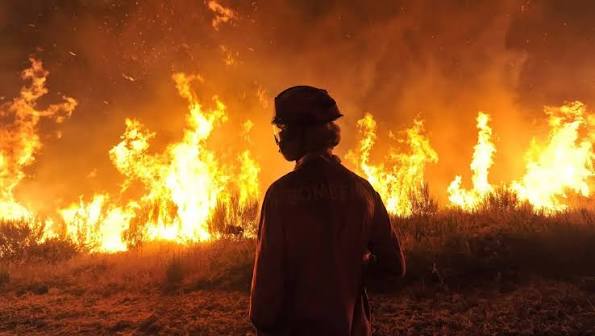
Portugal: Decision-making AI platform for fighting wildfires in testing stage
The SIION platform, described by its creator, João Santos, to Lusa as «a supermodel for firefighting», due to its ability to aid decision-making and anticipation using Artificial Intelligence, is already in the testing phase.
«The great advantage is being able to make decisions in a short space of time. This is an Artificial Intelligence tool that analyses a great deal of data, not quite in real time, but almost, and what would be almost impossible for a human to decide, the machine can now predict with a certain degree of confidence,» João Santos explained in an interview with Lusa.
SIION came second in the national final of ClimateLaunchpad, a competition for sustainable business ideas, which took place at UPTEC, the University of Porto’s Science and Technology Park, and is already being tested in a business context; its creator expects that between the end of this year and early 2027, it will be able to reach more companies and regions.
«Basically, it’s the next level in fire-fighting systems – a real-time recommendation system for the positioning of resources. It’s like a ‘GPS’ for fire commanders,» he adds.
SIION differs from other existing fire behaviour prediction systems by cross-referencing information to «suggest which resources are needed and where they should be deployed».
«We anticipate the decision, we call it a recommendation system, and we’re still at a very early stage. (…) [We want] to improve the efficiency of each resource when resources are scarce, and to anticipate dangerous areas for firefighters, as well as to determine the ideal resource for that type of fire,» he explains.
Platforms such as this, he believes, help not only to anticipate or speed up decision-making in firefighting but also to prevent the effects of day after day of field work.
«It reaches a point where processing so much information becomes challenging. Which way the wind is blowing, the type of ground, the nature of the flames… the machine can do all this in record time,» he said.
In tests to incorporate the technology into a product for real-world use, he describes it as «a supermodel of firefighting» that enables those involved to stay «one step ahead».
João Santos, from Lisbon, is 41 years old and comes from a family of firefighters, from his brother to most of his cousins. He has combined his degree in Forestry Engineering with a master’s degree in Artificial Intelligence and Data Science, which he obtained from the University of Liverpool in June.
He said that coming second in the UPTEC competition demonstrates «a certain need» for this type of solution in firefighting.
Latent Energy Systems won the competition; the company is developing a thermal storage solution to decarbonise industrial heat and will go on to the world final.
SIF/ADB // ADB.
Lusa